Chlorine dioxide (ClO₂) is an oxidizing compound widely used in water purification, sanitation, and certain food-processing applications. Its ability to inactivate microorganisms under controlled conditions has also generated interest among natural and alternative-health practitioners who investigate parasites and their possible relationship to human health.
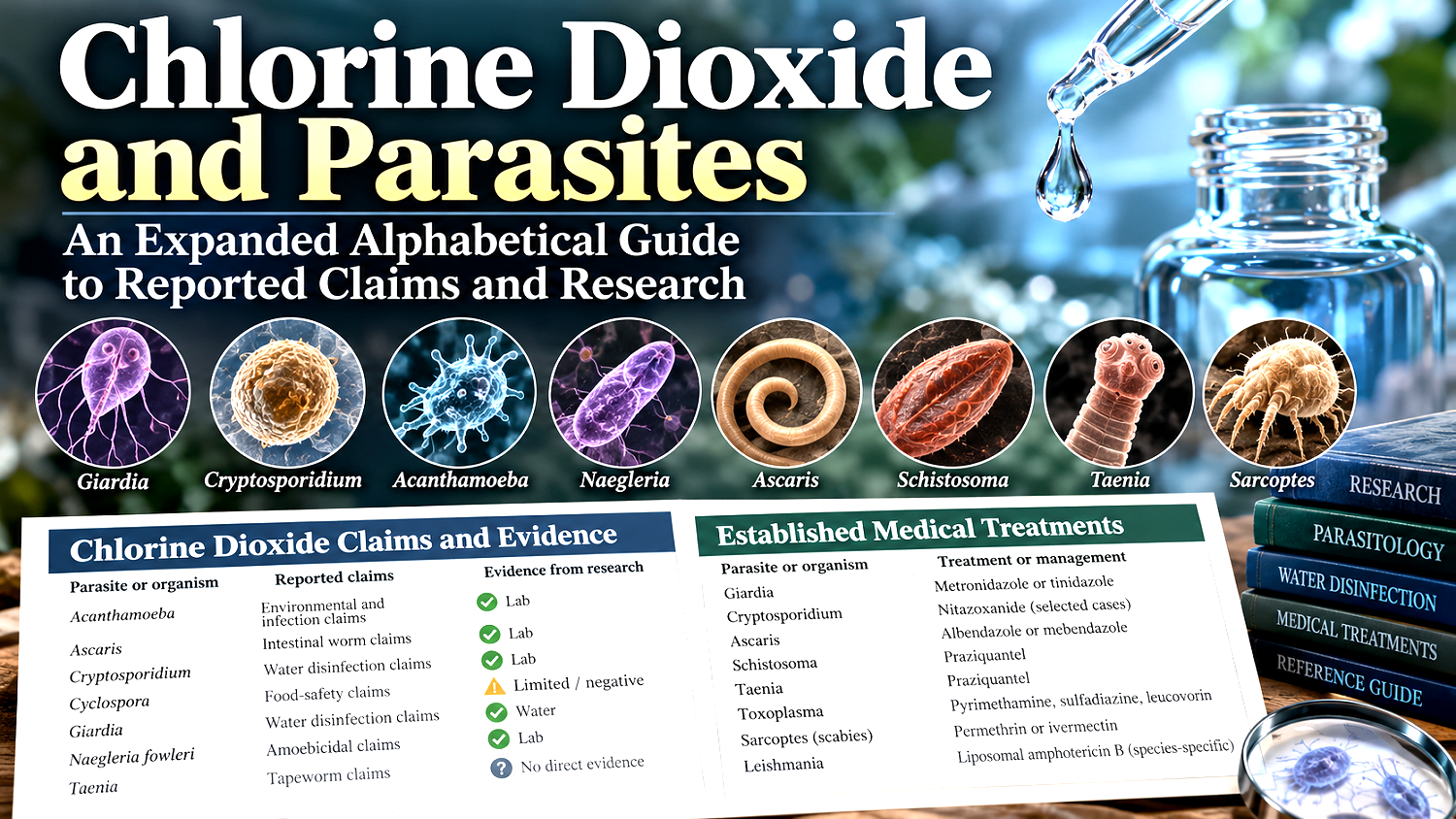
Over the years, authors and practitioners, including Jim Humble and Herb Roi Richards, have discussed chlorine dioxide in connection with a broad collection of organisms—from microscopic protozoa and intestinal worms to skin mites, lice, and parasites associated with animals.
Some of these discussions are based on personal testimonials or practitioner observations. Others relate to published studies examining chlorine dioxide’s effects on microorganisms in water, food, or laboratory environments.
Bringing these reports together reveals a much wider range of organisms than readers might initially expect.
The purpose of this guide is to provide an accessible alphabetical reference to those organisms, identify where they commonly occur, and indicate the kinds of chlorine dioxide evidence available.
The article does not assume that every reported effect has been clinically demonstrated. It distinguishes the existence of a claim from evidence that a particular application works.
Importantly, laboratory or water-treatment activity does not establish that chlorine dioxide is safe or effective for treating an infection inside a human or animal. Ingesting chlorine dioxide solutions can cause serious harm.

Understanding the Organisms
The term parasite encompasses several different groups.
Protozoa are microscopic, single-celled organisms, including Giardia, Cryptosporidium, Babesia, and Toxoplasma.
Helminths are parasitic worms, including roundworms, hookworms, tapeworms, whipworms, flukes, and filarial worms.
Ectoparasites live on or near the body’s surface and include lice and certain mites.
Free-living amoebae normally inhabit environmental settings such as soil and water. Some species can occasionally cause serious human infections.
Microsporidia are microscopic, fungus-related organisms, some of which are obligate intracellular parasites.
Although these organisms differ substantially in their biology, they appear together in discussions of chlorine dioxide’s antimicrobial and antiparasitic properties.
Parasite and Organism Reference
The following table combines organisms mentioned in alternative-health discussions with additional organisms investigated in chlorine dioxide disinfection research.
Evidence Key
- ✓ Water: Published evidence of activity in water-treatment conditions.
- ✓ Lab: Published experimental activity under specified laboratory conditions.
- ✓ Produce: Published activity in a food or produce-decontamination setting.
- △: Studied, but results were limited, mixed, or negative.
- ◇: Reported chlorine dioxide claim or practitioner discussion without qualifying organism-specific experimental evidence established here.
A checkmark refers to the setting indicated. It does not signify successful treatment of human infections.
| Parasite or organism | Classification | Typical source or association | Chlorine dioxide evidence |
| Acanthamoeba castellanii | Free-living amoeba | Soil, water, contact lens contamination | ✓ Lab |
| Acanthamoeba polyphaga | Free-living amoeba | Water, environmental biofilms | ✓ Lab |
| Allovahlkampfia spp. | Free-living amoeba | Environmental water systems | △ |
| Ancylostoma caninum | Hookworm | Dogs, contaminated soil | ◇ |
| Anisakis spp. | Marine roundworm | Raw or undercooked seafood | ◇ |
| Ascaris spp. | Roundworm | Contaminated soil and food | ◇ |
| Ascaris suum | Roundworm | Pigs, contaminated environments | ✓ Lab |
| Babesia spp. | Protozoan | Tick-associated infections | ◇ |
| Cryptosporidium spp. | Protozoan | Contaminated water | ✓ Water |
| Cyclospora cayetanensis | Protozoan | Contaminated fresh produce | △ |
| Demodex brevis | Skin mite | Human hair follicles and sebaceous glands | ◇ |
| Demodex folliculorum | Skin mite | Human hair follicles | ◇ |
| Diphyllobothrium latum | Tapeworm | Raw or undercooked freshwater fish | ◇ |
| Dipylidium caninum | Tapeworm | Fleas associated with dogs and cats | ◇ |
| Eimeria tenella | Protozoan | Poultry-associated coccidiosis | ✓ Lab |
| Encephalitozoon intestinalis | Microsporidian | Contaminated environments, food | ✓ Produce |
| Entamoeba histolytica | Protozoan | Contaminated food and water | ◇ |
| Giardia duodenalis | Protozoan | Contaminated water and food | ✓ Water |
| Leishmania spp. | Protozoan | Sandfly bites | ◇ |
| Naegleria fowleri | Free-living amoeba | Warm freshwater environments | ✓ Lab |
| Naegleria gruberi | Free-living amoeba | Environmental water | ✓ Water/Lab |
| Necator americanus | Hookworm | Contaminated soil | ◇ |
| Pediculus humanus | Louse | Close human contact | ◇ |
| Plasmodium falciparum | Protozoan | Mosquito-borne malaria | ◇ |
| Sarcoptes scabiei | Mite | Scabies infestation | ◇ |
| Schistosoma spp. | Blood fluke | Contaminated freshwater | ◇ |
| Stenamoeba spp. | Free-living amoeba | Environmental water | △ |
| Taenia saginata | Tapeworm | Undercooked beef | ◇ |
| Taenia solium | Tapeworm | Pork-associated tapeworm; eggs cause cysticercosis | ◇ |
| Toxocara canis | Roundworm | Dogs, contaminated soil | ◇ |
| Toxocara cati | Roundworm | Cats, contaminated soil | ◇ |
| Toxoplasma gondii | Protozoan | Foodborne and environmental exposure | ◇ |
| Trichinella spp. | Roundworm | Undercooked meat | ◇ |
| Trichomonas vaginalis | Protozoan | Sexually transmitted infection | ◇ |
| Trichuris trichiura | Whipworm | Contaminated soil | ◇ |
| Trichuris vulpis | Whipworm | Dogs | ◇ |
| Trypanosoma cruzi | Protozoan | Triatomine bug transmission | ◇ |
| Vermamoeba vermiformis | Free-living amoeba | Water-system biofilms | △ |
| Wuchereria bancrofti | Filarial worm | Mosquito-borne lymphatic filariasis | ◇ |
Evidence classifications summarize the reported research settings rather than clinical effectiveness. Experimental outcomes can vary with concentration, contact time, organism life stage, temperature, and other conditions.
The chart above documents organisms discussed or investigated in connection with chlorine dioxide. The following companion chart takes a different approach, identifying established medical treatments for these organisms where applicable. The two charts serve different purposes: one catalogs claims and experimental disinfection findings; the other summarizes clinical treatment options. They should not be interpreted as demonstrating equivalent medical effectiveness.
Companion Reference: Established Medical Treatments for Parasites
The following chart corresponds to the organisms in the chlorine dioxide evidence table. It identifies commonly recognized human medical treatments where applicable, while distinguishing organisms primarily relevant to veterinary medicine or environmental disinfection research.
Treatment choices depend on the organism, confirmed diagnosis, infection site, severity, pregnancy status, immune function, and other clinical considerations. The table is a general reference, not a prescribing guide.
| Parasite or organism | Established treatment or management | Notes |
| Acanthamoeba castellanii | Specialist-directed combination therapy; topical biguanides for keratitis | Eye infections differ substantially from invasive disease |
| Acanthamoeba polyphaga | Specialist-directed combination therapy | Treatment depends on the infection site |
| Allovahlkampfia spp. | No standardized human regimen | Primarily environmental; rare reported infections require specialist evaluation |
| Ancylostoma caninum | Albendazole or ivermectin for cutaneous larva migrans | Human infection usually involves migrating larvae rather than adult intestinal worms |
| Anisakis spp. | Endoscopic removal; occasionally surgery | Associated with raw or undercooked seafood |
| Ascaris spp. | Albendazole, mebendazole, or ivermectin | Established intestinal roundworm treatments |
| Ascaris suum | Albendazole or mebendazole for human intestinal infection | Primarily a pig-associated parasite |
| Babesia spp. | Atovaquone plus azithromycin; alternative regimens for selected cases | Severe cases may require hospital treatment |
| Cryptosporidium spp. | Rehydration; nitazoxanide for eligible patients | Immune status strongly influences management |
| Cyclospora cayetanensis | Trimethoprim-sulfamethoxazole (TMP-SMX) | Recognized treatment for cyclosporiasis |
| Demodex brevis | Topical ivermectin or other dermatologic treatments when indicated | Presence alone does not require treatment |
| Demodex folliculorum | Topical ivermectin or other condition-specific treatment | Often associated with rosacea or follicular inflammation |
| Diphyllobothrium latum | Praziquantel | Fish tapeworm; now often classified under Dibothriocephalus |
| Dipylidium caninum | Praziquantel | Flea control is important to prevent reinfection |
| Eimeria tenella | Veterinary anticoccidial medications | Poultry parasite; not a routine human infection |
| Encephalitozoon intestinalis | Albendazole | Especially relevant in immunocompromised patients |
| Entamoeba histolytica | Metronidazole or tinidazole, followed by a luminal agent such as paromomycin | Both tissue and intestinal infection must be addressed |
| Giardia duodenalis | Tinidazole, metronidazole, or nitazoxanide | Commonly treated intestinal protozoan infection |
| Leishmania spp. | Liposomal amphotericin B, miltefosine, or other species-specific therapies | Depends on cutaneous, mucosal, or visceral disease |
| Naegleria fowleri | Emergency multidrug treatment under specialist supervision | Rare, rapidly progressive, life-threatening infection |
| Naegleria gruberi | No routine human treatment | Primarily an environmental research organism |
| Necator americanus | Albendazole or mebendazole | Human hookworm infection |
| Pediculus humanus | Permethrin or other approved pediculicides; ivermectin in selected cases | Treatment differs for head and body lice |
| Plasmodium falciparum | Artemisinin-based combination therapy; intravenous artesunate for severe malaria | Prompt treatment is essential |
| Sarcoptes scabiei | Permethrin cream or oral ivermectin | Close contacts may also need management |
| Schistosoma spp. | Praziquantel | Species and infection stage influence treatment |
| Stenamoeba spp. | No standardized human regimen | Primarily environmental; limited clinical evidence |
| Taenia saginata | Praziquantel | Intestinal beef tapeworm |
| Taenia solium | Praziquantel for intestinal infection; specialist-directed albendazole and/or praziquantel for selected cysticercosis cases | Brain or eye involvement requires special precautions |
| Toxocara canis | Albendazole or mebendazole for visceral disease | Ocular disease requires specialized management |
| Toxocara cati | Albendazole or mebendazole for visceral disease | Treatment depends on organ involvement |
| Toxoplasma gondii | Pyrimethamine, sulfadiazine, and leucovorin when indicated | Many healthy individuals need no treatment |
| Trichinella spp. | Albendazole or mebendazole; corticosteroids for selected severe cases | Early treatment is preferable |
| Trichomonas vaginalis | Metronidazole or tinidazole | Sexual partners also require appropriate management |
| Trichuris trichiura | Albendazole or mebendazole; selected combination regimens | Treatment success varies |
| Trichuris vulpis | Veterinary deworming medications | Primarily a canine whipworm |
| Trypanosoma cruzi | Benznidazole or nifurtimox | Treatment decisions depend on disease stage and patient factors |
| Vermamoeba vermiformis | No established routine human treatment | Mainly relevant to environmental microbiology |
| Wuchereria bancrofti | Diethylcarbamazine where appropriate; other regimens in public-health programs | Chronic lymphatic complications may need additional management |
The treatments listed above are established or recognized approaches for the indicated organisms, but they are not interchangeable. Some entries involve rare infections, specialized medical care, or veterinary treatment. The chart does not recommend self-diagnosis, preventive medication without an appropriate indication, or use of veterinary medications in humans.
Parasites With Documented Chlorine Dioxide Disinfection Research
Several organisms deserve particular attention because they have been investigated experimentally.
Giardia and Cryptosporidium: The Water-Treatment Foundation
Giardia and Cryptosporidium are among the most frequently discussed parasites in chlorine dioxide water-purification research.
Both can cause gastrointestinal illness after exposure to contaminated water.
Chlorine dioxide can inactivate these organisms under appropriate treatment conditions, although Cryptosporidium is particularly resistant to many common disinfection approaches.
This research helps explain why chlorine dioxide is used in certain drinking-water treatment products.
It does not establish that ingesting chlorine dioxide solutions treats giardiasis or cryptosporidiosis after infection.
Ascaris suum: Research Involving Roundworm Eggs
Ascaris suum is a roundworm primarily associated with pigs.
A published 2024 veterinary parasitology study investigated the effects of chlorine dioxide exposure on its eggs.
The researchers reported inhibition of egg development under the experimental conditions.
This finding expands the chlorine dioxide research discussion beyond microscopic waterborne protozoa.
However, directly exposing parasite eggs to a disinfectant is different from eliminating adult worms or larvae inside a living host.
The study does not establish chlorine dioxide as a human deworming treatment.
Encephalitozoon intestinalis: Food-Decontamination Research
Encephalitozoon intestinalis is a microsporidian organism capable of causing infection, particularly in people with weakened immune systems.
Research published in 2008 examined chlorine dioxide gas as a method for reducing contamination involving microsporidian spores on fresh produce.
The study reported reductions under the tested conditions.
This is an example of environmental antimicrobial activity that may be relevant to food-safety research.
It does not establish a treatment for microsporidiosis inside the human body.
Eimeria tenella: Poultry-Associated Protozoa
Eimeria tenella is a protozoan parasite associated with coccidiosis in poultry.
A 2025 study investigated gaseous chlorine dioxide in relation to Eimeria contamination under experimental conditions.
This provides another example of research involving parasite-related organisms outside the context of human medical treatment.
Its findings should be interpreted according to the experimental conditions and the measured outcomes.
Cyclospora cayetanensis: A Useful Negative Finding
Cyclospora cayetanensis is a foodborne protozoan parasite associated with outbreaks involving contaminated produce.
A 2008 study examined gaseous chlorine dioxide in relation to Cyclospora oocysts.
Under the conditions tested, the treatment did not demonstrate the anticipated effect on oocyst sporulation.
This is an important reminder that chlorine dioxide’s antimicrobial properties do not guarantee effectiveness against every organism or developmental stage.
Negative findings are part of the evidence record and help define the limits of a proposed application.
Free-Living Amoebae: An Additional Area of Research
The expanded search also identified research involving free-living amoebae.
These organisms normally inhabit environmental settings rather than living exclusively as parasites.
Some, however, can cause serious human infections.
Acanthamoeba
Acanthamoeba species are found in soil, water, and other environmental settings.
Certain species can cause infections involving the eyes or, more rarely, other tissues.
Studies have examined chlorine dioxide’s activity against Acanthamoeba under laboratory conditions.
These findings are relevant to environmental disinfection, but they do not establish chlorine dioxide as a treatment for Acanthamoeba infections in humans.
Naegleria
Naegleria fowleri is associated with a rare but severe brain infection following contaminated freshwater entering the nose.
Other Naegleria species, including Naegleria gruberi, have been used in environmental and laboratory research.
Published studies have investigated chlorine dioxide against Naegleria organisms.
This research contributes to understanding disinfection methods for environmental water systems.
It does not establish chlorine dioxide as a treatment for Naegleria infections.
Vermamoeba, Allovahlkampfia, and Stenamoeba
These free-living amoebae are relevant to environmental water systems and biofilm research.
Some studies have examined their responses to disinfectants, including chlorine dioxide.
Results vary, and some organisms or life stages can be relatively resistant.
Their inclusion illustrates how research on chlorine dioxide extends into water-system microbiology beyond the parasites most familiar to consumers.
Parasites Discussed Primarily in Alternative-Health Literature
The remaining organisms in the table are included because they appear in practitioner discussions, historical MMS literature, or broader parasite-cleansing articles.
These include:
- Bloodborne and tissue protozoa such as Babesia, Leishmania, Plasmodium, Toxoplasma, and Trypanosoma.
- Intestinal worms such as hookworms, whipworms, tapeworms, and roundworms.
- External parasites such as lice, scabies mites, and Demodex.
- Filarial worms and blood flukes associated with infections outside the intestinal tract.
The reported claims generally emphasize chlorine dioxide’s oxidizing properties and propose that these properties might affect parasites or their developmental stages.
However, the existence of an oxidative mechanism in a disinfectant does not demonstrate that the compound can safely reach and eliminate parasites inside the body.
These entries are included as a record of the claims being discussed, not as verified medical applications.
Why Laboratory Results and Human Recovery Stories Are Different
A parasite may be directly exposed to chlorine dioxide in a laboratory dish, water sample, or food-processing experiment.
In that environment, researchers can control the amount of disinfectant, exposure time, temperature, and other conditions.
Inside the human body, circumstances are very different.
Parasites may occupy tissues, organs, blood cells, or other locations where a disinfectant cannot simply be applied without also affecting the host.
The body’s chemistry may also change how a substance behaves.
For these reasons, successful environmental disinfection does not establish safe or effective treatment of an established infection.
Human therapeutic claims require separate evidence of effectiveness, appropriate exposure, and safety.
Pets, Food, Water, and Environmental Exposure
The expanded parasite list also illustrates the many routes through which people encounter parasitic organisms.
Some are associated with untreated drinking water.
Others are transmitted through inadequately cooked meat or seafood.
Certain parasites are associated with soil contaminated by animal or human feces.
Others require insect vectors such as mosquitoes, ticks, sandflies, or fleas.
Cats and dogs can participate in the transmission cycles of particular parasites, but pet ownership does not automatically indicate that a person is infected.
Understanding these differences is important because parasite prevention is not a single activity.
Safe water, proper food preparation, veterinary care, environmental hygiene, and appropriate medical evaluation each address different exposure risks.

A Growing Reference, Not a Final Verdict
The expanded list demonstrates that chlorine dioxide has been discussed or investigated in connection with a wider range of organisms than Giardia and Cryptosporidium alone.
Published research includes studies involving roundworm eggs, microsporidian spores, free-living amoebae, and certain foodborne protozoa.
Other claims remain part of alternative-health literature and practitioner discussions without established clinical evidence.
The most useful approach is to keep those categories visible.
A laboratory finding is not a human clinical outcome.
A testimonial is not a controlled experiment.
And a reported improvement does not automatically establish what caused it.
At the same time, documenting claims accurately can help readers understand what has been proposed and what questions remain unanswered.
What Has Been Studied, What Has Been Reported, and What Remains Unknown
Chlorine dioxide’s documented antimicrobial activity has supported its use in controlled disinfection applications for many years.
Its activity against certain waterborne parasites is well established under appropriate conditions.
Additional experimental studies involving roundworm eggs, foodborne protozoa, microsporidia, and free-living amoebae broaden the research picture.
Beyond those findings lies an extensive collection of parasite-related claims appearing in alternative-health publications and practitioner reports.
An alphabetical reference makes those discussions easier to examine without treating every claim as equally established.
As further research becomes available, the chart can be updated to reflect new findings, including positive, negative, and inconclusive results.
For now, the most useful distinction remains straightforward:
What has been reported, what has been demonstrated, and what remains to be investigated are three different things.
References and Further Reading
The following references include published scientific research, public-health guidance, and alternative-health publications discussing chlorine dioxide and parasites.
They are organized by source type to help readers distinguish experimental findings and established clinical guidance from practitioner claims, historical accounts, and personal observations.
Published Scientific Research
Zhang, R., et al. (2024).
Evaluation of the efficacy of disinfectants and disinfection methods against Ascaris suum eggs.
Veterinary Parasitology, 332, 110333.
Examines chlorine dioxide and other disinfectants against pig roundworm eggs under laboratory conditions, including prolonged exposure.
https://doi.org/10.1016/j.vetpar.2024.110333
Ortega, Y. R., Mann, A., Torres, M. P., & Cama, V. (2008).
Efficacy of gaseous chlorine dioxide as a sanitizer against Cryptosporidium parvum, Cyclospora cayetanensis, and Encephalitozoon intestinalis on produce.
Journal of Food Protection, 71(12), 2410–2414.
Investigates chlorine dioxide gas applied to contaminated basil and lettuce. The researchers reported reductions in Cryptosporidium and Encephalitozoon, while Cyclospora sporulation was unaffected under the tested conditions.
https://doi.org/10.4315/0362-028X-71.12.2410
Sohn, H.-J., et al. (2024).
Amoebicidal effect of chlorine dioxide gas against pathogenic Naegleria fowleri and Acanthamoeba polyphaga.
Parasitology Research.
Investigates chlorine dioxide gas against two medically important free-living amoebae under controlled laboratory conditions.
https://doi.org/10.1007/s00436-024-08215-z
Cursons, R. T. M., Brown, T. J., & Keys, E. A. (1980).
Effect of disinfectants on pathogenic free-living amoebae: In axenic conditions.
Applied and Environmental Microbiology, 40(1), 62–66.
Compares disinfectants, including chlorine dioxide, against Naegleria and Acanthamoeba species.
https://doi.org/10.1128/AEM.40.1.62-66.1980
Evaluation of Gaseous Chlorine Dioxide as a Sanitizer to Inactivate Cryptosporidium parvum and Eimeria tenella on Produce (2025).
Food Control, 178, 111450.
Examines chlorine dioxide gas against protozoan oocysts on tomatoes, carrots, and blueberries. Eimeria tenella was used as a research surrogate for Cyclospora cayetanensis.
https://doi.org/10.1016/j.foodcont.2025.111450
Research Note — Eimeria tenella and Cyclospora cayetanensis
In the 2025 study, researchers used Eimeria tenella as a surrogate organism when investigating chlorine dioxide gas for produce decontamination. Although the findings contribute to our understanding of chlorine dioxide’s activity against certain protozoan oocysts, they should not be interpreted as demonstrating equivalent effectiveness against Cyclospora cayetanensis.
This distinction is especially relevant because an earlier 2008 study found that gaseous chlorine dioxide did not affect Cyclospora oocyst sporulation under the conditions tested.
Consequently, the alphabetical evidence chart identifies Eimeria tenella as ✓ Lab and Cyclospora cayetanensis as △ Studied, limited or negative findings.
Public-Health and Medical References
U.S. Environmental Protection Agency (EPA).
Drinking Water Distribution System Tools and Resources.
Provides information about water-system disinfection and the control of microbial pathogens, including Giardia and Cryptosporidium.
https://www.epa.gov/dwreginfo/drinking-water-distribution-system-tools-and-resources
U.S. Environmental Protection Agency (EPA).
Stage 1 and Stage 2 Disinfectants and Disinfection Byproducts Rules.
Explains the importance of controlling waterborne pathogens while limiting potentially harmful disinfection byproducts.
https://www.epa.gov/dwreginfo/stage-1-and-stage-2-disinfectants-and-disinfection-byproducts-rules
Centers for Disease Control and Prevention (CDC).
A–Z Index of Parasitic Diseases.
A starting point for information about human parasites, transmission, prevention, and clinical management.
https://www.cdc.gov/parasites/listing/index.html
Centers for Disease Control and Prevention (CDC).
DPDx: Laboratory Identification of Parasites of Public Health Concern.
A reference for parasite identification, classification, and diagnostic information.
https://www.cdc.gov/dpdx/az.html
Centers for Disease Control and Prevention (CDC).
Clinical Care of Leishmaniasis.
Illustrates why antiparasitic treatment must account for the organism, disease presentation, geographic exposure, and patient circumstances.
https://www.cdc.gov/leishmaniasis/hcp/clinical-care/index.html
How to Interpret These References
Published disinfection studies demonstrate what researchers observed under particular experimental conditions. They do not establish that the same effects occur safely or effectively inside the human body.
Public health and medical references provide information about parasite identification, prevention, and recognized clinical management.
Readers interested in a particular organism are encouraged to compare the relevant references, paying attention to the type of evidence, research setting, and outcomes actually measured.
The central distinction is between what has been reported, what has been experimentally demonstrated, and what remains to be investigated.
Disclaimer: This article is provided for informational and historical research purposes. It does not recommend chlorine dioxide ingestion, enemas, eye applications, or other unapproved uses for treating parasitic infections. Chlorine dioxide is not established as a safe or effective human antiparasitic medication, and ingestion can cause serious harm. Suspected parasitic infections should be evaluated by an appropriately qualified healthcare professional.
