One of the strangest things about chlorine dioxide is the enormous variety of stories surrounding it. People talk about chlorine dioxide in connection with infections, Lyme disease, digestive problems, skin conditions, inflammation, neurological complaints, joint problems, dental applications, waterborne pathogens, and dozens of other seemingly unrelated concerns. That creates an obvious problem.
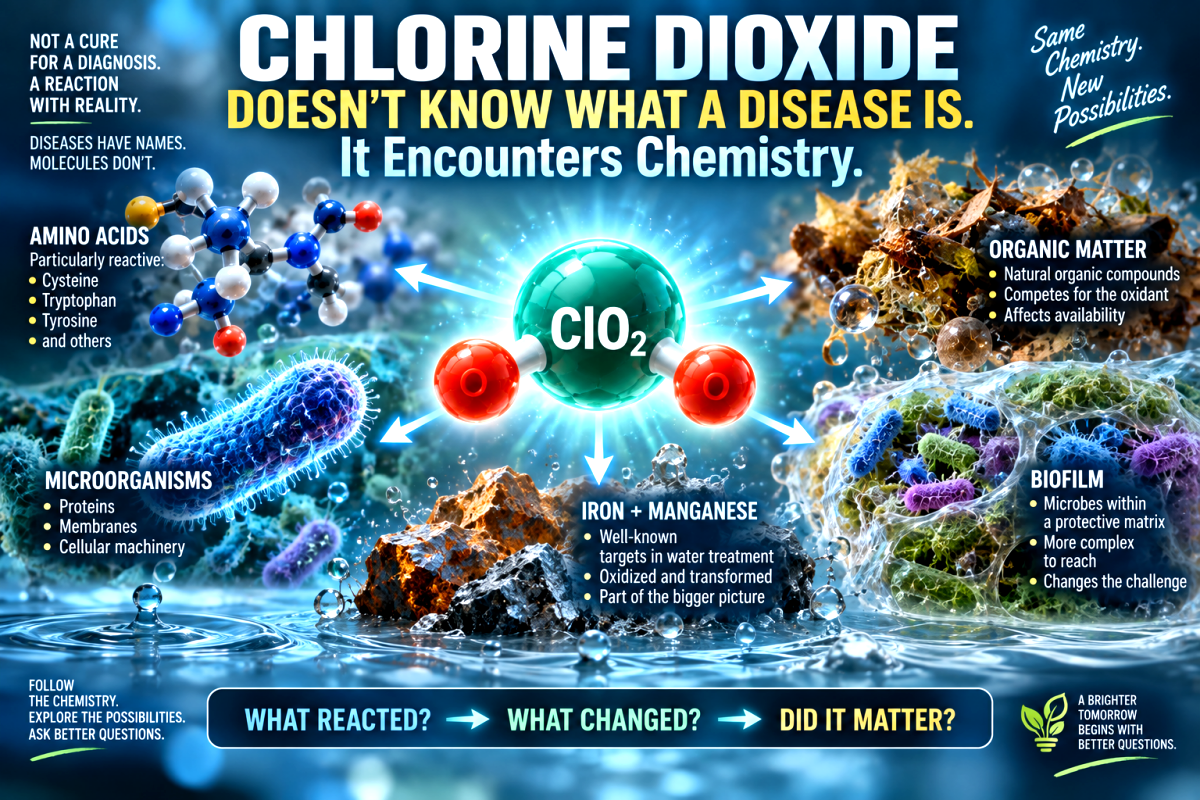
How could one simple substance possibly know what condition someone has? It doesn’t.
A chlorine dioxide molecule has never heard of Lyme disease. It doesn’t know what Parkinson’s disease is. It cannot recognize arthritis, osteoporosis, Candida, a urinary tract infection or anything else written in a medical chart. It encounters chemistry.
And perhaps that is where a more useful investigation should begin.
The Disease Has a Name. The Molecule Doesn’t Care.
We humans organize illness by diagnoses. That makes perfect sense. Diagnoses help doctors communicate, researchers conduct studies, insurance companies categorize treatment and patients understand what is happening to them.
Chemistry operates differently. When chlorine dioxide encounters its surroundings, it doesn’t encounter a diagnosis. It encounters molecules. Proteins. Amino acids. Microorganisms. Organic compounds. Inorganic compounds. Cell membranes. Biological material.
And some of those potential reaction partners are considerably more attractive to chlorine dioxide than others.
That gives us a different question from the one commonly asked in alternative-health circles.
Instead of: “What diseases does chlorine dioxide work on?” perhaps we should first ask: What does chlorine dioxide actually react with? That turns out to be a much more interesting question.

Chlorine Dioxide Is an Oxidizer—but That Doesn’t Mean It Oxidizes Everything Equally
Chlorine dioxide, or ClO₂, is a powerful oxidizing agent. But the word oxidizer can create the wrong mental picture. It doesn’t mean that chlorine dioxide indiscriminately attacks everything it encounters at precisely the same speed. Its chemistry is selective.
Reviews of chlorine-dioxide water-treatment chemistry describe ClO₂ as reacting preferentially with certain electron-rich molecular structures, including phenols, amines, olefins and related compounds. That’s important.
Think of a crowded room containing hundreds of people. Someone entering that room might technically be capable of speaking with anyone. But that doesn’t mean every conversation is equally likely. Chemical reactions are somewhat similar.
Different molecules present different opportunities for reaction. Their structures matter. Their concentrations matter. Their surroundings matter. Temperature matters. And reaction speed matters.
So chlorine dioxide doesn’t simply enter an environment and “oxidize everything.” There is competition.
Some Amino Acids Are Particularly Interesting
Proteins are constructed from amino acids. And chlorine dioxide doesn’t react with every amino acid identically.
Laboratory studies have demonstrated particularly rapid reactions involving amino acids including cysteine, tryptophan and tyrosine. Other amino acids react differently or much more slowly under the experimental conditions studied.
A review of chlorine dioxide’s antimicrobial mechanisms likewise describes oxidation of amino-acid residues including tyrosine, tryptophan and cysteine as part of its ability to alter proteins.
Now something important happens. We’re no longer saying: “Chlorine dioxide kills germs.” We’re beginning to ask: “Which molecular structures within those germs are particularly vulnerable to chlorine dioxide chemistry?”
That’s a much deeper level of investigation.
A Microorganism Isn’t Just a Tiny Target
A bacterium isn’t simply a little object waiting to be “killed.” It has membranes, proteins, enzymes and complex molecular machinery that must continue functioning for the organism to survive. Oxidative damage to important structures can interfere with that machinery.
Research into oxidative disinfectants shows that bacterial inactivation can involve multiple targets and secondary reactions rather than one universal mechanism.
That gives us another useful distinction. There is a difference between: chlorine dioxide touching a microorganism and enough reactive chlorine dioxide reaching sufficiently vulnerable structures for long enough to disable that organism.
That distinction becomes extremely important when we leave a laboratory flask and enter a complicated environment.
Because Something Else May Get There First
Suppose chlorine dioxide is introduced into water containing microorganisms. But the water also contains iron. Manganese. Organic matter. Other reactive compounds.
Chlorine dioxide doesn’t politely ignore those substances while searching for the bacterium we’re worried about. It reacts according to chemistry.
In fact, this is one reason chlorine dioxide has uses in water treatment extending beyond microbial disinfection.
EPA material describes chlorine dioxide as capable of oxidizing iron and manganese, converting them into forms that can subsequently be removed through treatment processes. Chlorine dioxide can also react with interfering organic material.
Suddenly we have an important concept:
Oxidant Demand
Everything reactive in an environment potentially competes for the available oxidant. So asking: “How much chlorine dioxide was present?” isn’t necessarily enough.
We may also need to ask: “What did it encounter first?”
The Journey Matters as Much as the Destination
Imagine sending 100 delivery trucks toward a destination. On paper, 100 trucks departed. But along the way: 20 made deliveries at the first town. 15 stopped at the second. 30 unloaded somewhere else. Several broke down. Only the remainder reached the final destination. Knowing what left the warehouse doesn’t tell you what arrived.
Something conceptually similar matters in reactive chemistry. A substance may begin at one concentration, but reactions along the way consume it.
That is obvious in water treatment, where engineers must account for water chemistry, oxidant demand, concentration, and contact time. It becomes even more important when people begin extrapolating environmental chemistry into biology.
The human body is enormously more complicated than a glass of purified water.
And This Is Where We Need to Be Careful
It would be tempting to make the next leap: “If chlorine dioxide selectively oxidizes certain molecules in water, it must selectively find undesirable molecules inside the human body.”
We don’t have evidence for that conclusion. Selective chemical reactivity is real.
Therapeutic selectivity is an entirely different claim.
A chemical can prefer certain reaction partners without possessing any ability to distinguish: healthy versus unhealthy or desirable versus undesirable or disease-causing versus beneficial.
That’s why understanding chlorine dioxide’s chemistry is interesting, but doesn’t automatically establish a medical treatment.
And this distinction becomes especially interesting when microorganisms change how they live.
What If the Microbe Lives Behind a Wall?
Most people picture bacteria as individual organisms floating around independently. Sometimes they are. Scientists call free-floating microorganisms planktonic cells.
But microorganisms can also organize themselves into communities attached to surfaces. These are called: Biofilms
Biofilms can contain microorganisms embedded within a protective extracellular matrix. That matrix changes the problem dramatically.
Instead of an antimicrobial encountering a relatively exposed microorganism, it may encounter layers of material surrounding a microbial community. This can alter antimicrobial penetration and effectiveness.
That’s one reason biofilms matter so much in medicine, industry and drinking-water systems.
The Fortress Around the Microbe
A biofilm is almost like a microbial neighborhood surrounded by infrastructure. The matrix can contain polysaccharides, proteins, extracellular DNA, and other components. And microorganisms living inside biofilms can behave differently from their free-floating counterparts.
A 2024 review of drinking-water biofilms found that disinfectants – including chlorine dioxide – can affect microbial communities, culturable organisms, biofilm biomass, and components of the biofilm matrix. But effectiveness depends on multiple environmental and treatment variables.
Environmental research has also demonstrated chlorine dioxide activity against biofilm-associated microorganisms, including recent work involving Pseudomonas aeruginosa and Staphylococcus aureus.
But this should not be translated into: “Therefore chlorine dioxide removes human biofilms and cures biofilm-associated disease.” That’s another bridge requiring evidence.
Instead, the research teaches us something more fundamental. The physical state of a microorganism matters.
Same Organism. Different Problem.
Consider this. A researcher puts a microorganism into a suspension. Chlorine dioxide reaches it readily. The organism is inactivated.
Now put genetically similar organisms inside a mature biofilm. Suddenly, the antimicrobial must contend with:
the surrounding matrix → other microorganisms → reactive organic material → penetration limitations → different microbial physiology
The organism’s name hasn’t changed. But the chemical problem has.
That’s why the question: “Does chlorine dioxide kill organism X?” can be less informative than it initially sounds.
A better question might be:
Under what conditions, at what concentration and contact time, and in what physical state is organism X susceptible to chlorine dioxide?
That’s how disinfectant researchers think about these problems. And perhaps that mindset has something to teach us about the health claims surrounding chlorine dioxide.

Herb Roi Richards’ Observations Become a Different Kind of Question
Herb Roi Richards has collected reports involving chlorine dioxide and a surprisingly broad range of health concerns. Those reports are not controlled clinical trials. But suppose, simply for purposes of investigation, that some portion of the reported improvements eventually prove reproducible.
We would still have a major problem. It wouldn’t make biological sense to say: “Chlorine dioxide knows how to treat all these different diseases.” It doesn’t.
Instead, researchers might ask whether apparently unrelated conditions sometimes contain shared upstream biological features.
Perhaps microbial ecology is relevant in one group. Perhaps inflammatory signaling is relevant somewhere else. Perhaps gastrointestinal function or barrier integrity matters in another. Perhaps the chlorine-dioxide exposure changes nothing clinically meaningful in still another. And perhaps some reported improvements have nothing whatsoever to do with chlorine dioxide.
Those possibilities can coexist.
The important point is that diagnostic labels don’t tell us what the molecule encountered.
Lyme Disease Provides an Interesting Example
Herb and his wife have described their own experiences with chronic Lyme-related illness and attribute their recovery to the approaches they pursued, including chlorine dioxide.
That experience doesn’t establish chlorine dioxide as a Lyme disease treatment. But Lyme gives us a useful example of why molecular and microbial context matters.
Borrelia burgdorferi, the bacterium responsible for Lyme disease, has been extensively studied in different morphological and physiological states.
The important lesson isn’t that chlorine dioxide therefore treats Lyme disease.
It is this: The same named microorganism can present a very different chemical challenge depending upon its environment and biological state.
That’s exactly the kind of distinction that disappears when everything gets reduced to: “Does it kill Lyme?”
Killing Something Isn’t Necessarily the End of the Story Either
Here’s another layer. Suppose an antimicrobial successfully damages a microorganism. What happens next?
Microbial structures don’t simply vanish. Cellular components remain. The surrounding biological environment may respond. Immune systems respond to microbial material. Biofilm material may remain. Other organisms may occupy the ecological space.
And recent drinking-water research is even examining how different disinfectants influence the release of bacterial endotoxins from biofilms. Again, drinking-water pipes are not human intestines.
But the underlying lesson is useful: “Microorganism killed” isn’t necessarily the final biological event. There can be downstream consequences.
That means a serious investigation into chlorine dioxide shouldn’t stop with: What did it kill? We should also ask:
- What did the reaction create?
- What remained afterward?
- What changed in the surrounding environment?
- Other Research Starts to Look Different
This perspective gives us an interesting way to revisit some of the questions previously explored.
Osteoporosis manifests in bone, but intestinal absorption, microbiome activity, immune signaling, and inflammation can influence bone remodeling. We discovered the gut–bone axis.
With Parkinson’s disease, we discovered the microbiome–gut–brain axis, intestinal dysfunction, α-synuclein research, and proposed body-first versus brain-first pathways.
Those investigations didn’t establish chlorine dioxide as a treatment for either condition. But they demonstrated why starting with the final diagnosis can sometimes obscure the interesting biology.
The skeleton may be downstream. The brain may be downstream. The symptom may be downstream.
So perhaps another question should accompany: “What does chlorine dioxide react with?” It is: “Where in the biological chain did something change?”
Oxidation Is an Event, Not an Explanation
This distinction may be one of the most important. Saying: “Chlorine dioxide oxidizes things.” doesn’t explain a health outcome.
Oxidation is chemistry. A clinical improvement is biology experienced by an entire human being. There are numerous steps between them.
We would need to establish: What was oxidized?
- Then: What products were created?
- Then: What biological pathway changed?
- Then: Did that pathway affect the disease?
- Then: Did the person’s objective health actually improve?
Each arrow requires evidence. That is a much higher standard than simply saying: “Chlorine dioxide is an oxidizer, and the person got better.”
But it is also far more interesting.
The Three Questions We Keep Mixing Together
Perhaps chlorine dioxide discussions would improve enormously if we separated three questions.
- What is chlorine dioxide chemically capable of doing?
We have considerable laboratory and water-treatment research addressing this.
- What does chlorine dioxide actually encounter under a particular exposure?
That depends on concentration, route, environment, competing reaction partners, contact time and many other variables.
- Does any resulting chemical change produce a meaningful health benefit?
That’s the clinical question.
And evidence for Question One does not automatically answer Questions Two or Three.
This distinction lets us be curious without getting ahead of ourselves.
Maybe This Is Why Chlorine Dioxide Seems So Confusing
People naturally organize their experiences according to disease.
- Someone with Lyme disease says: “It helped my Lyme.”
- Someone else says: “It helped my digestive problem.”
- Someone else: “My joint problem improved.”
- Someone else: “Something neurological changed.”
Soon we have a list of dozens of apparently unrelated conditions.
That list sounds increasingly implausible because we’re asking one substance to possess dozens of disease-specific abilities. But perhaps that’s not the right way to organize the observations.
Chlorine dioxide doesn’t encounter the names of those diseases. It encounters chemistry.
If some of the reports eventually prove reproducible, perhaps seemingly unrelated outcomes will turn out to share something upstream.
- Maybe microbial.
- Maybe metabolic.
- Maybe inflammatory.
- Maybe environmental.
- Maybe something we haven’t identified.
And undoubtedly, some reports may ultimately have entirely different explanations.
That’s what research is for.
Follow the Chemistry
The established science already gives us a starting point. Chlorine dioxide is an oxidizing disinfectant.
- It reacts selectively with particular electron-rich molecular structures.
- It reacts readily with certain amino-acid residues.
- It can damage microorganisms through oxidative mechanisms.
- It can oxidize substances other than microorganisms, including iron, manganese and organic compounds encountered during water treatment.
- Its effectiveness against microorganisms depends upon environmental conditions, exposure and the state in which microorganisms exist – including whether they are associated with biofilms.
Those are established starting points.
What they do not establish is that internal chlorine-dioxide use treats systemic disease. A 2025 laboratory study examining acidified sodium chlorite/chlorine-dioxide preparations specifically noted that medicinal evidence remains very limited while investigating both antimicrobial activity and cytotoxicity – another reminder that antimicrobial action and safe therapeutic action are different questions.
So perhaps the next generation of chlorine-dioxide research shouldn’t begin with an enormous list of diseases.
Begin smaller.
- What did the molecule encounter?
- What reacted?
- What changed afterward?
- Where did that change occur?
- Can we measure it?
- Can we reproduce it?
And only then:
- Did it matter to the person?
The Disease Has a Name. The Molecule Still Doesn’t Care.
Maybe one reason chlorine dioxide remains so confusing is that we’ve been organizing the conversation by diseases rather than chemistry.
We ask: How could one substance possibly affect so many unrelated conditions?
Perhaps researchers should begin one level deeper.
A chlorine dioxide molecule doesn’t know whether the person holding the glass has Lyme disease, Parkinson’s disease, arthritis, or no disease whatsoever. It encounters whatever chemistry happens to be in front of it.
Some reactions happen rapidly. Others happen slowly. Some substances consume it. Some microorganisms are vulnerable. Biofilms can change the challenge.
And an enormous amount remains unknown when we attempt to extrapolate those reactions from controlled water-treatment and laboratory environments into the extraordinary complexity of a living human body. That uncertainty isn’t disappointing. It’s where the interesting work begins.
Instead of starting with: “What diseases can chlorine dioxide treat?” perhaps we should start with the much simpler question: “What does chlorine dioxide actually react with?”
Then follow the chemistry wherever it leads.
Informational Notice
This article examines chlorine-dioxide chemistry and questions raised by anecdotal health reports. Laboratory antimicrobial activity and established water-treatment applications do not demonstrate that chlorine dioxide safely or effectively treats disease in humans. Chlorine dioxide is a reactive oxidant, and inappropriate exposure can cause harm. References to individual experiences, including those reported by Herb Roi Richards, are presented as observations that may generate research questions rather than evidence of clinical efficacy.
