Hair loss has inspired an extraordinary number of solutions over the years. Shampoos. Supplements. Medications. Laser devices. Scalp massage. Nutritional programs. Oils. Transplants. And then there is one approach most people have probably never heard about: chlorine dioxide.
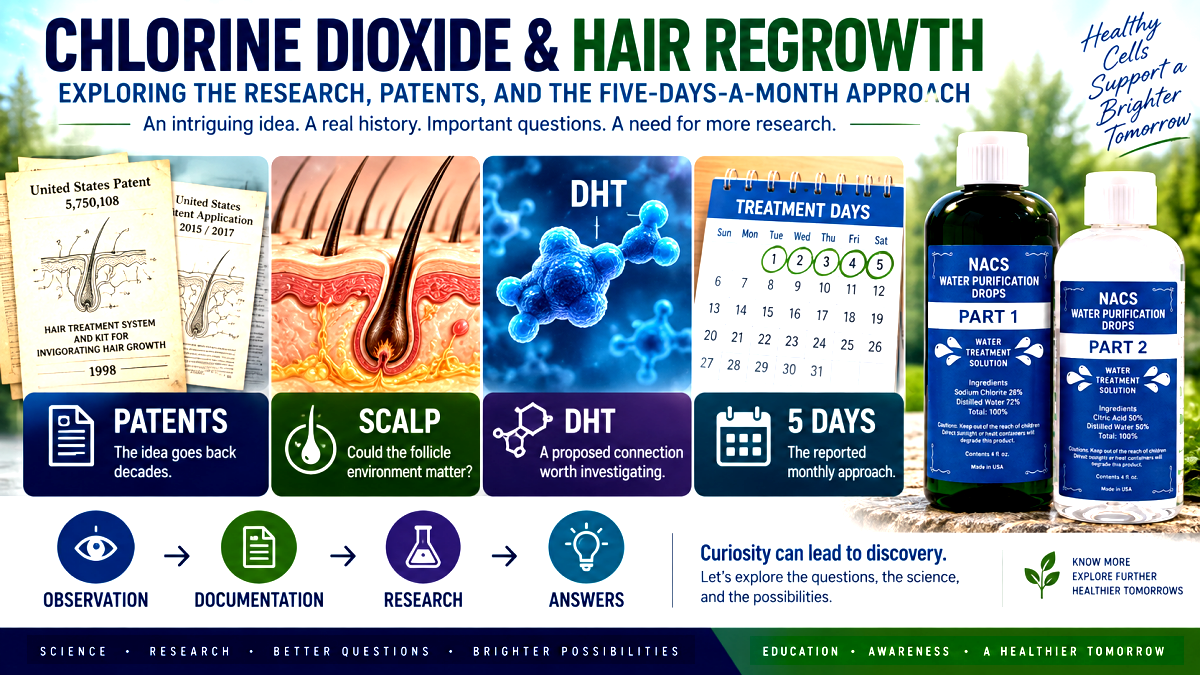
More specifically, we recently became aware of a method in which chlorine dioxide is reportedly applied topically to areas of thinning hair for five consecutive days each month, followed by a break for the remainder of the month.
The reported objective is not simply cleaner hair. It is hair regrowth. That naturally raises a question: Where did this idea come from?
As unusual as it sounds, chlorine dioxide and hair growth actually have a documented history stretching back decades.
A Hair-Growth Patent from the 1990s
One of the most interesting pieces of this story is U.S. Patent No. 5,750,108, titled Hair Treatment System and Kit for Invigorating Hair Growth. Issued in 1998, the patent describes a multi-step approach to treating the scalp that included chlorine dioxide. The inventors proposed several possible reasons chlorine dioxide might be useful in a hair-care system.
Among them were removing debris from follicles, reducing microorganisms on the scalp, and influencing 5-alpha-reductase—the enzyme involved in converting testosterone to dihydrotestosterone, better known as DHT. That last point is especially interesting because DHT plays an established role in androgenetic alopecia, commonly called male- or female-pattern hair loss.
The patent’s hypothesis was essentially that improving the environment surrounding the follicle while addressing processes associated with DHT might create conditions more favorable for hair growth.
But there’s an important distinction:
A patent can describe a biological theory and an invention without proving that the theory works clinically.
Another Chlorine Dioxide Hair-Growth Patent
The idea did not disappear.
A later patent publication specifically described a “hair-growth-promoting solution containing chlorine dioxide.” This formulation was considerably more complicated. Chlorine dioxide was combined with various potential ingredients, including plant extracts, conditioners, and—in some formulations—DMSO.
The inventors proposed several mechanisms, including influencing 5-alpha-reductase and DHT, addressing dandruff and scalp microorganisms, improving penetration into the scalp, and creating a more favorable environment surrounding hair follicles.
Again, these are claims and hypotheses contained in a patent, not conclusions from large randomized clinical trials. Still, the existence of multiple patents tells us something important: The idea of investigating chlorine dioxide for hair growth isn’t something that appeared on social media last week.
People have been exploring it for decades.

What About the Hair Follicle Itself?
A hair follicle isn’t simply a hole from which a hair emerges. It’s a tiny biological structure. Hair cycles through different phases, including active growth, transition, resting, and shedding. The condition surrounding the follicle matters too.
Sebum, inflammation, microorganisms, hormones, genetics, age, nutrition, medications, autoimmune conditions, and numerous other factors can influence hair and scalp health.
This helps explain why researchers and inventors have explored so many different approaches to hair loss. The chlorine dioxide hypothesis appears to focus partly on changing the environment surrounding the follicle, rather than merely coating the existing hair.
Chlorine Dioxide and DHT
This may be the most intriguing—and most speculative—part of the story.
DHT is strongly associated with androgenetic alopecia in genetically susceptible individuals. The 1998 patent proposed that chlorine dioxide could affect 5-alpha-reductase, thereby influencing the pathway associated with DHT. A later patent pursued essentially the same concept and proposed both reducing DHT’s influence and improving conditions around the follicle.
That’s an interesting hypothesis. It is not the same thing as demonstrating in controlled human research that topical chlorine dioxide reverses androgenetic alopecia. That study would still need to be done.
Then There’s the Scalp-Cleansing Question
There is another, much simpler possibility behind the interest in chlorine dioxide. Chlorine dioxide is an oxidizing antimicrobial agent. That makes researchers interested in what happens when the environment surrounding a follicle is changed.
The early patent specifically discusses sebum and debris surrounding follicles and the antimicrobial properties of chlorine dioxide. This produces an interesting research question:
Could altering the scalp environment indirectly affect hair growth in some people?
We don’t yet have strong clinical evidence establishing that it does. But it is a testable question.
Where Does the Five-Day Method Come In?
This is where the story becomes less certain. The method brought to our attention calls for topical use on the affected scalp for:
Five consecutive days each month.
Then nothing for the remainder of the month. Then another five-day cycle the following month.
I could not locate a peer-reviewed clinical study validating that particular schedule. Nor did the patents I reviewed establish this exact five-days-per-month regimen. One related patent describes intermittent courses, but those treatment periods were longer.
Therefore, at present, the five-day schedule is best described as a reported experimental regimen, not a scientifically established hair-regrowth protocol. That distinction matters.
Why Would Someone Use It Intermittently?
The intermittent nature is nevertheless interesting. Hair grows slowly. Follicles operate according to biological cycles measured in weeks and months, not hours.
So whoever developed the five-day approach may have been working from the premise that continuous application isn’t necessary—that a short period of intervention followed by a longer period of observation might be sufficient.
That’s a hypothesis, however, rather than something we can presently demonstrate from published evidence. And it raises some excellent research questions.
- Would five days differ from ten?
- Would continuous treatment produce different results?
- Would the outcome depend upon the type of hair loss?
- Does anything measurable happen to follicular activity after treatment stops?
Those are exactly the kinds of questions controlled research could answer.
Not All Hair Loss Is the Same
This point is particularly important. “Hair loss” isn’t one disease.
Someone may lose hair because of:
- androgenetic alopecia
- alopecia areata
- hormonal changes
- nutritional deficiencies
- thyroid disorders
- medications
- severe illness or stress
- fungal or inflammatory scalp conditions
- traction
- scarring alopecia
- normal aging
A treatment that theoretically affects one cause might do absolutely nothing for another. That’s one reason extraordinary before-and-after photographs don’t answer the scientific question by themselves.
We need to know what type of hair loss the person had in the first place.
Anecdotes Can Start Research—They Don’t Finish It
Suppose ten people try the five-day approach and eight report new hair.
That’s interesting. It deserves documentation. But it still doesn’t establish cause and effect.
Hair naturally cycles. Some conditions spontaneously improve. People frequently change multiple things simultaneously. Photography and hair length can exaggerate apparent differences.
The next logical step would be controlled investigation.
Researchers could photograph standardized scalp locations, count hairs, measure hair diameter and density, identify the type of alopecia beforehand, and compare treated and untreated groups over several months.
Then we would have something much more meaningful than testimonials.

What We Know—and What We Don’t
At this point, the evidence presents an unusual picture.
We do know that chlorine dioxide has been proposed for topical hair-growth applications for decades and appears in multiple patent documents devoted specifically to hair loss.
We do know that plausible mechanisms involving scalp microorganisms, follicular debris, and DHT pathways have been proposed. But we do not know from robust controlled human trials that topical chlorine dioxide reliably regrows hair. And I could not substantiate the specific five consecutive days every month schedule from scientific literature.
That doesn’t make the observation worthless. It makes it a question.
A Question Worth Investigating
Some of the most interesting discoveries in medicine began when someone noticed something unexpected.
Observation came first. Then documentation. Then experimentation. Then controlled research. The chlorine dioxide and hair-growth story appears to still be somewhere near the beginning of that progression.
There is enough history behind the concept to make it more than a passing curiosity. There isn’t enough high-quality clinical evidence to call it an established hair-loss treatment. And somewhere between those two statements lies an excellent opportunity for investigation.
If people are genuinely experiencing hair regrowth after short, intermittent topical exposure, that phenomenon should be documented carefully rather than exaggerated—or dismissed. Because the most scientifically interesting question isn’t: “Do you believe chlorine dioxide grows hair?”
It’s: “What actually happens when we test it?”
Educational Notice
This article is provided for educational and research purposes and does not recommend chlorine dioxide as a treatment for hair loss. Chlorine dioxide is a strong oxidizing agent and can irritate or injure tissue depending on concentration, formulation, exposure, and route. The patent formulations discussed above should not be interpreted as do-it-yourself instructions. Anyone experiencing unexplained or significant hair loss should consider professional evaluation because hair loss can have many underlying causes.
