Bone and skeletal disorders affect millions of people worldwide and range from traumatic fractures to inherited genetic conditions and degenerative diseases. Many can lead to chronic pain, reduced mobility, spinal deformities, repeated fractures, disability, and a significant impact on quality of life. Because conventional treatments do not always restore normal bone structure or eliminate symptoms, some individuals seek complementary approaches in addition to standard medical care. Within alternative health communities, chlorine dioxide is one of the substances that has generated discussion, with personal testimonials describing improvements in a variety of musculoskeletal conditions.
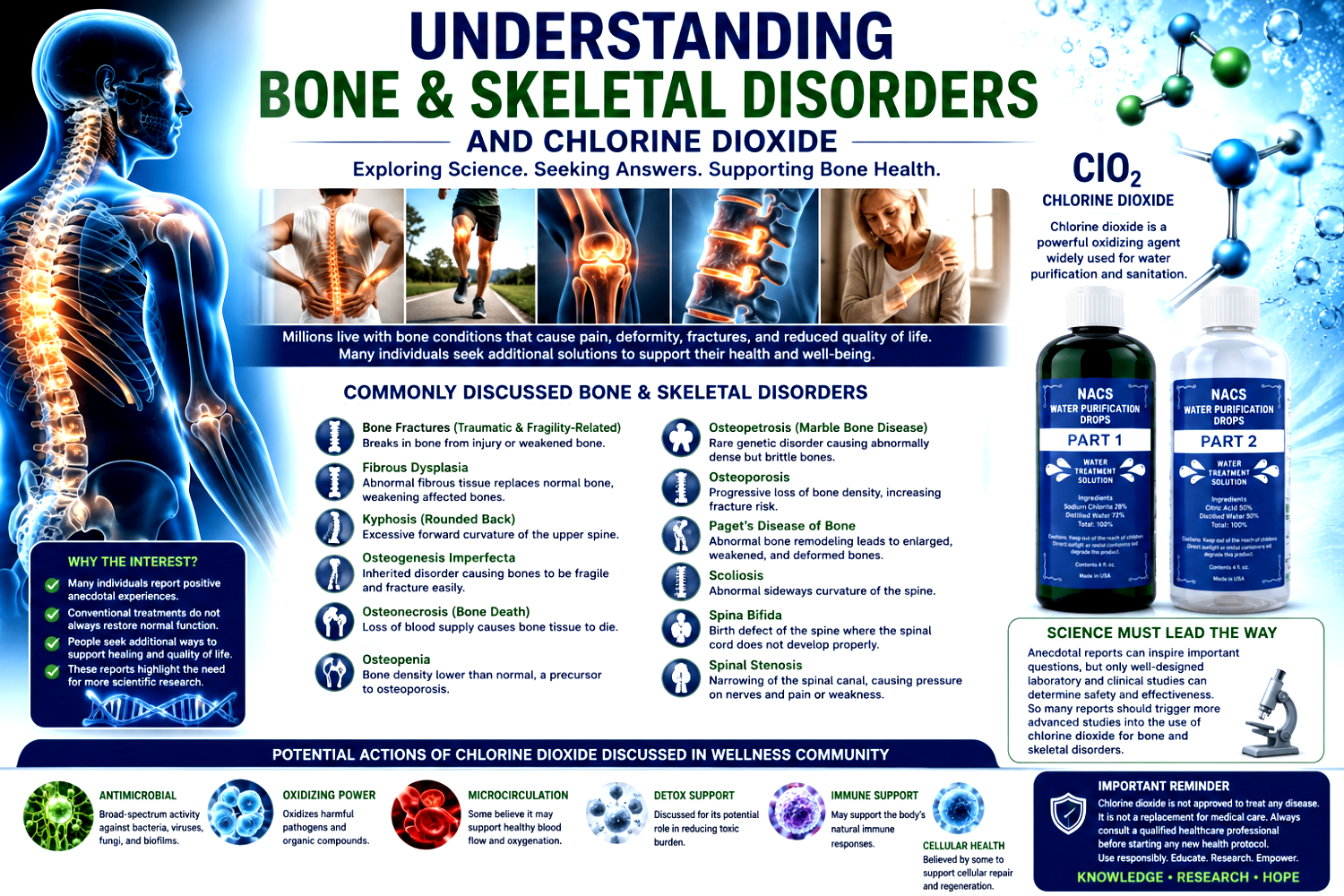
These personal accounts have prompted interest among some patients and practitioners. However, there is currently no high-quality clinical evidence demonstrating that chlorine dioxide is a safe or effective treatment for bone and skeletal disorders. The reported experiences remain anecdotal and should not be interpreted as proof of efficacy.
Understanding Bone & Skeletal Disorders
The skeletal system provides structural support, protects internal organs, stores minerals, and enables movement through its interaction with muscles and connective tissues.
Disorders affecting the bones and spine may involve:
- Reduced bone density
- Abnormal bone remodeling
- Poor fracture healing
- Congenital abnormalities
- Chronic inflammation
- Degenerative changes
- Mechanical compression of nerves
- Genetic defects affecting bone formation
Many conditions require lifelong management by orthopedic specialists, rheumatologists, endocrinologists, rehabilitation teams, or neurosurgeons.
Commonly Discussed Conditions
| Disorder | Brief Description | Why It Draws Interest in Alternative Health Discussions* |
| Bone Fractures (Traumatic & Fragility-Related) | Breaks in bone resulting from injury or weakened bone. | Some individuals describe recovery experiences alongside standard fracture care. |
| Fibrous Dysplasia | A rare disorder in which normal bone is replaced by fibrous tissue, weakening affected bones. | Some people explore complementary wellness approaches because treatment options are limited. |
| Kyphosis | Excessive forward curvature of the upper spine. | Individuals may seek supportive therapies to improve comfort and function. |
| Osteogenesis Imperfecta | An inherited disorder characterized by fragile bones that fracture easily. | Families sometimes investigate complementary approaches in addition to specialized medical care. |
| Osteonecrosis | Death of bone tissue resulting from loss of blood supply. | Because progression can be disabling, patients often explore multiple treatment options. |
| Osteopenia | Bone density lower than normal but not yet osteoporosis. | Often discussed in the context of long-term bone health strategies. |
| Osteopetrosis | A rare genetic condition causing abnormally dense but brittle bones. | Interest arises because available treatments are limited. |
| Osteoporosis | Progressive loss of bone density, increasing fracture risk. | Commonly discussed by individuals seeking comprehensive bone health support. |
| Paget’s Disease of Bone | A disorder of abnormal bone remodeling leading to enlarged and weakened bones. | Some individuals seek complementary approaches alongside conventional treatment. |
| Scoliosis | Abnormal sideways curvature of the spine. | People sometimes explore supportive therapies aimed at mobility and comfort. |
| Spina Bifida | A congenital condition affecting spinal development before birth. | Families often investigate supportive approaches in addition to multidisciplinary care. |
| Spinal Stenosis | Narrowing of the spinal canal that may compress nerves and cause pain or weakness. | Individuals frequently seek additional options to complement conventional management. |
*These summaries describe why the conditions are discussed in some wellness communities. They do not demonstrate that chlorine dioxide is an effective treatment.

Why Are People Discussing Chlorine Dioxide?
Most discussions surrounding chlorine dioxide in relation to bone disorders come from personal testimonials rather than controlled clinical research.
People who share these experiences may also report making other changes at the same time, such as:
- Improvements in nutrition
- Increased physical rehabilitation
- Better hydration
- Weight management
- Lifestyle modifications
- Conventional medical treatment
- Natural changes in disease progression
Because these factors can occur together, it is not possible to determine from testimonials alone whether chlorine dioxide contributed to the reported outcomes.
What Properties of Chlorine Dioxide Are Commonly Discussed?
Chlorine dioxide is best known for its established uses in:
- Drinking water purification
- Municipal water treatment
- Food sanitation
- Environmental sanitation
- Biofilm control in certain water systems
Some people have proposed that these chemical properties could have broader biological implications. However, such hypotheses have not been confirmed as effective therapies for bone diseases or spinal disorders, and laboratory observations cannot substitute for evidence from well-designed human clinical trials.
Why Scientific Research Is Important
Throughout the history of medicine, patient observations have sometimes helped generate new research questions. Reports from patients can highlight areas that deserve closer examination.
However, anecdotal reports cannot answer important scientific questions such as:
- Is the intervention actually effective?
- Is it safe?
- Which patients, if any, might benefit?
- What dose would be appropriate?
- What are the risks?
- How does it compare with existing treatments?
Those questions require carefully designed laboratory studies followed by rigorous clinical trials before reliable conclusions can be drawn.
Established Uses vs. Investigational Questions
It is helpful to distinguish between two different conversations.
Established Uses
Chlorine dioxide has recognized applications in:
- Water treatment
- Drinking water disinfection
- Food sanitation
- Industrial sanitation
- Environmental hygiene
Investigational Questions
Some people have suggested exploring whether chlorine dioxide could have broader biological effects relevant to various health conditions. At present, these ideas remain investigational, and no clinical evidence establishes chlorine dioxide as an effective treatment for osteoporosis, fractures, spinal disorders, or other bone diseases.

Bone and skeletal disorders encompass many different diseases, each with unique causes and treatment approaches. Patients facing these conditions understandably seek options that may improve quality of life.
Although chlorine dioxide continues to be discussed in some wellness communities, current scientific evidence does not establish it as a treatment for bone and skeletal disorders. Personal testimonials can help generate research questions, but they cannot determine safety or effectiveness.
Continued high-quality research into promising hypotheses remains an important part of medical progress. Any proposed therapy should ultimately be evaluated through rigorous scientific investigation before clinical recommendations are made.
