Natural wellness has rarely been about finding a single product that does everything. Instead, many practitioners have believed that lasting wellness comes from combining simple tools that each contribute something unique. That philosophy appears repeatedly throughout Herb Roi Richards’ book, Chlorine Dioxide for Humans: Recipes & Treatment. One companion product stands out more than almost any other. Virgin coconut oil.
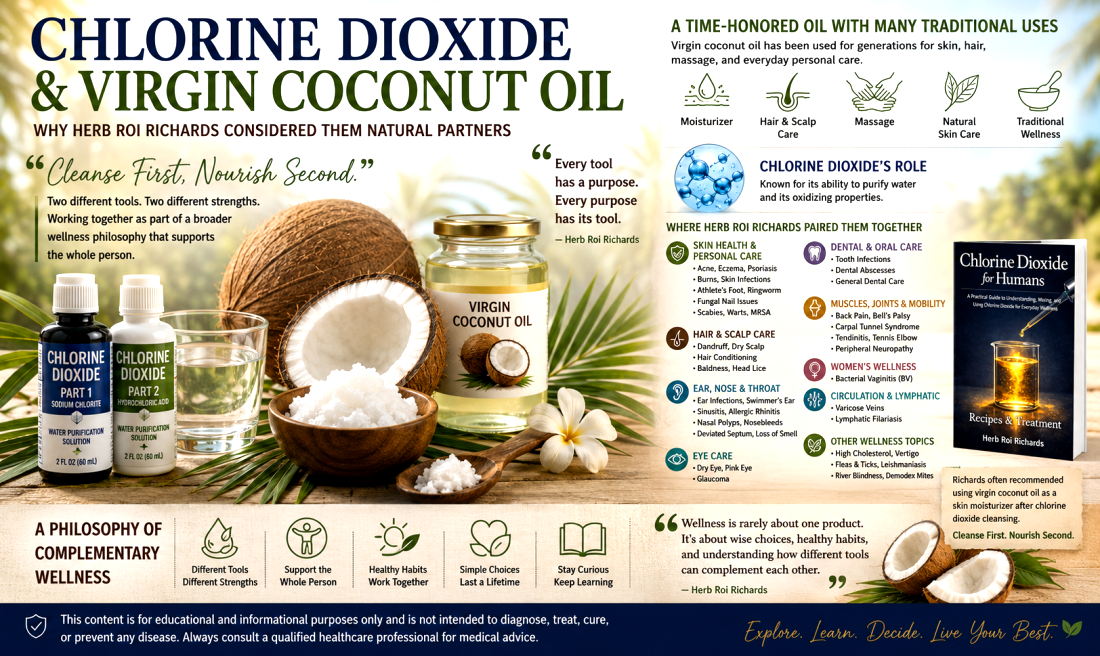
Readers quickly notice that Richards frequently discusses virgin coconut oil alongside chlorine dioxide—not because he believed they performed the same function, but because he believed each supported a different part of a broader wellness philosophy. In his view, they worked hand in hand. Not as competitors. As complementary partners.
Different Tools. Different Strengths.
Throughout his writing, Richards often encouraged readers to think like a craftsman. A mechanic doesn’t repair every problem with one wrench. A carpenter doesn’t build an entire house using only a hammer. Every tool has its own purpose. Richards believed wellness worked much the same way.
Chlorine dioxide occupied one place in his overall philosophy. Virgin coconut oil occupied another. One was discussed primarily for its oxidative properties and established role in water purification. The other was valued for its long tradition as a nourishing botanical oil used for skin, hair, massage, and personal care. Rather than replacing one another, Richards believed they complemented each other naturally.
A Long Tradition of Virgin Coconut Oil
Virgin coconut oil has been used for generations throughout tropical regions of the world. Long before modern skin-care products filled store shelves, people relied on coconut oil for everyday personal care.
Traditionally, it has been used to:
- moisturize dry skin
- soften rough areas
- condition hair
- care for the scalp
- massage tired muscles
- support everyday skin comfort
Its popularity has endured because it is simple, versatile, and familiar to millions of people around the world. Richards saw those traditional qualities as fitting naturally beside chlorine dioxide within his overall wellness philosophy.
Herb’s Most Consistent Recommendation
Among the many references to virgin coconut oil throughout Chlorine Dioxide for Humans: Recipes & Treatment, one recommendation appears more often than any other. After cleansing… nourish.
Richards frequently suggested that after using chlorine dioxide as part of a cleansing routine, virgin coconut oil could be applied as a natural skin moisturizer.
Whether readers agree with that approach or simply appreciate the philosophy behind it, this simple pattern appears repeatedly throughout the book.
Cleanse first. Nourish second.
It became one of the defining themes of Richards’ work.
Where Herb Most Often Paired Virgin Coconut Oil with Chlorine Dioxide
Rather than thinking about individual illnesses, Richards often approached wellness through body systems. Throughout his book, virgin coconut oil appears alongside chlorine dioxide in discussions involving many different areas of personal care and wellness.

Skin Health and Personal Care
Perhaps no category appears more often than skin care.
Examples include discussions involving:
- acne
- burns
- eczema
- psoriasis
- general skin care
- athlete’s foot
- ringworm
- fungal nail concerns
- scabies
- skin infections
- MRSA discussions
- warts
Richards frequently emphasized moisturizing and caring for the skin after cleansing routines.
Hair and Scalp Care
Virgin coconut oil also appears throughout chapters involving healthy hair and scalp care.
These include discussions involving:
- dandruff
- dry scalp
- hair conditioning
- baldness
- head lice
Its traditional role as a natural conditioner made it one of Richards’ favorite companion products.
Ear, Nose, and Throat Wellness
Richards frequently paired coconut oil with chlorine dioxide while discussing concerns involving the ears, nose, and sinuses.
Topics include:
- ear infections
- swimmer’s ear
- middle ear infections
- ruptured eardrum
- cholesteatoma
- allergic rhinitis
- sinusitis
- nasal polyps
- deviated septum
- nosebleeds
- loss of smell
Eye Care
Several chapters discuss eye-related concerns, including:
- dry eyes
- conjunctivitis (pink eye)
- glaucoma
Dental and Oral Care
Richards also references virgin coconut oil in discussions involving oral wellness.
These include:
- tooth infections
- dental abscesses
- general dental care
Muscles, Joints, and Mobility
Another recurring category involves physical comfort and movement.
Examples include:
- back discomfort
- Bell’s palsy
- carpal tunnel syndrome
- tendinitis
- tennis elbow
- peripheral neuropathy
Women’s Wellness
Richards also includes virgin coconut oil in discussions involving:
- bacterial vaginitis (BV)
Circulation and Lymphatic Support
Several chapters discuss circulation and lymphatic concerns, including:
- varicose veins
- lymphatic filariasis (elephantiasis)
Other Wellness Discussions
Additional topics found throughout the book include:
- high cholesterol
- vertigo and Ménière’s disease
- demodex mites
- fleas and ticks
- leishmaniasis
- river blindness (onchocerciasis)
These examples reflect the way Richards organized his book and presented his personal wellness philosophy. They should not be interpreted as established medical treatments for these conditions.
Looking Beyond Individual Symptoms
One of the most interesting aspects of Richards’ writing is that he rarely focused on isolated symptoms. Instead, he viewed wellness as the sum of many interconnected parts.
- Healthy skin contributes to comfort.
- Comfort contributes to better sleep.
- Better sleep supports energy.
- Energy affects daily living.
Rather than asking, “What product fixes this problem?” Richards often asked, “What healthy habits work well together?”
His philosophy consistently emphasized hydration, wholesome nutrition, movement, sunlight, rest, stress management, chlorine dioxide, and companion products like virgin coconut oil.
A Philosophy of Complementary Wellness
Perhaps the greatest takeaway from Richards’ work is not about coconut oil itself. It is about perspective. He rarely searched for one miracle solution. Instead, he believed that thoughtful combinations of healthy habits often provided a stronger foundation than relying on any single product alone.
Virgin coconut oil represented one part of that larger picture. Chlorine dioxide represented another. Together they reflected Richards’ belief that complementary practices may support overall well-being when incorporated into a balanced lifestyle.
Continuing the Conversation
Interest in traditional wellness continues to grow as people seek to better understand both modern science and time-honored practices.
Herb Roi Richards’ Chlorine Dioxide for Humans: Recipes & Treatment offers readers an opportunity to explore one practitioner’s integrated approach to wellness and the complementary role he believed virgin coconut oil could play alongside chlorine dioxide.
Whether readers agree with every conclusion or simply appreciate the questions he raises, Richards consistently encourages curiosity, observation, and personal responsibility.
Perhaps his most enduring message is also his simplest:
Wellness is rarely about one product.
It is about making wise choices, developing healthy habits, and understanding how different tools may complement one another as part of a thoughtful approach to caring for the whole person.
Educational Notice
This article summarizes themes from Herb Roi Richards’ Chlorine Dioxide for Humans: Recipes & Treatment and discusses the traditional uses of virgin coconut oil alongside Richards’ personal wellness philosophy. It is provided for educational and informational purposes only. References to virgin coconut oil reflect traditional practices and references to chlorine dioxide reflect the author’s perspective. This article should not be interpreted as medical advice or as evidence that these approaches are established treatments for any disease or medical condition. Readers are encouraged to conduct their own research, evaluate the available scientific literature, and consult qualified healthcare professionals when making decisions about their health.
